
Climate Finance’s New Playbook: Four HR&A Practitioners on What Climate Work Looks Like Now
Adaptation is not only a climate question. It requires finance, design, engineering, and policy to come together around infrastructure investment, land use, housing, and economic development. That is why our climate practice is built as a cross-disciplinary group rather than a specialty bench. Similarly, our decarbonization work charting effective pathways to reducing emissions also requires cross-sector expertise.
Foreword by CEO Jeff Hébert:
When I work on climate resilience projects across the country, the hardest conversations are rarely about the issues or the solutions. That’s actually a sign of how far climate work has come over the past several decades. The hard part now is figuring out how to pay for it, and getting all the stakeholders aligned to move forward.
That gap between a good plan and a funded one is where HR&A has worked for 50 years. Today that means assessing climate financial risk for Honolulu, building a proactive, durable funding and financing strategy for climate resilience in the State of Maine, helping Pittsburgh plan a just transition citywide.
Adaptation is not only a climate question. It requires finance, design, engineering, and policy to come together around infrastructure investment, land use, housing, and economic development. That is why our climate practice is built as a cross-disciplinary group rather than a specialty bench. Similarly, our decarbonization work charting effective pathways to reducing emissions also requires cross-sector expertise.
Four of our colleagues spend their days in that gap. I asked them what has actually changed for their clients as political tides have turned, what the cities getting this right are doing differently, and where the work goes next as federal support recedes.
HR&A is taking this challenge head on.
The following conversation features Partner Jon Meyers, Director Hannah Glosser, Partner Amitabh Barthakur, and Partner Ignacio Montojo on what happens to climate projects when the money gets harder to find.
Two years on, what has held up in your clients’ climate plans, and what has not?
Amitabh Barthakur: These are issues that bleed out of political boundaries. Beaches and waterfronts are continuous. They don’t stop at the edge of a city or a county. But we still look to individual political subdivisions to solve the problem. In Los Angeles, we just went through a major disaster with the fires. The pain was felt across multiple jurisdictions and taxing entities, and the response is still being organized one entity at a time. That’s the problem we increasingly have to solve.
Jon Meyers: And the tools we’ve used to address these problems, mostly a mix of federal and local funding and planning, have been upended. That’s stressful for disaster response, infrastructure financing, and planning. But it also demands innovation on problems that are technically clear and, in terms of implementation, feel entirely up in the air.
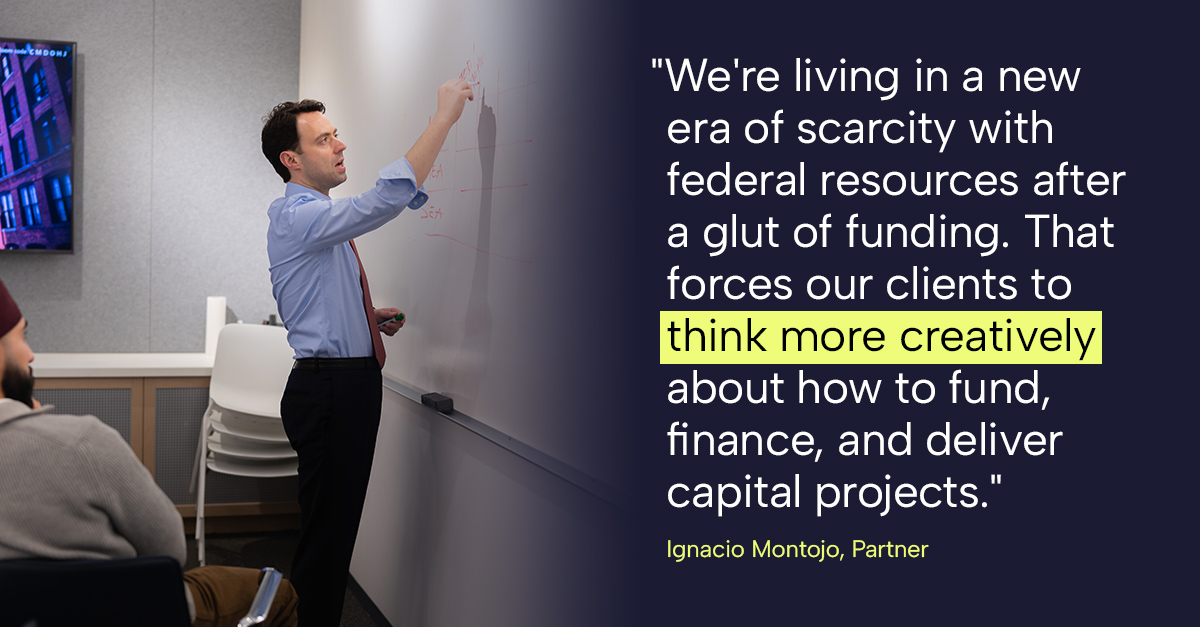
Ignacio Montojo: We’re living in a new era of scarcity with federal resources after a glut of funding. That forces our clients to think more creatively about how to fund, finance, and deliver capital projects. They now have to devise more sophisticated mechanisms, like value capture or monetizing assets, and then figure out how to co-mingle those resources with other jurisdictions while also relying more on private capital. That structuring work isn’t new for us. What’s new is that clients need that creativity for projects that used to be a federal grant application.
Hannah Glosser: More people are being brought into the fold now, asking: “How do we fund this? Who helps when disaster strikes?” We’re in conversations right now with a client where it’s hard to decipher what’s a climate project versus an infrastructure project. Today, good infrastructure has to be climate infrastructure. And this means more people can be part of the solution, instead of people only focused on addressing climate.
The way we talk about climate has also changed. Today affordability is the new paradigm. How has that changed what you do?
Ignacio Montojo: We’re doing work in Florida, where over three years, multifamily insurance costs in a market like Clearwater grew by roughly 60 percent. If you’re a landlord operating a rental multifamily building, you suddenly have to raise rents or eat that cost. So when we’re dealing with any capital or real estate project now, climate is central to how we design and plan it, purely because of the cost and life-cycle implications of making a project resilient and adaptable.
Hannah Glosser: You can see how they could conflict. When we’re funding infrastructure, one of our revenue tools is taxes, which strains affordability. When we’re focused on affordable housing, climate work can mean lost units and relocated residents. It’s easy to push the climate angle aside, but they do not have to be zero-sum. A lot of our work has been rethinking relocation itself, so it’s not only about where people leave but where they go. Where to upzone, where to add density, where it’s safe to live. That’s been core to work in New York, Nantucket, and Pittsburgh.
How do you make the case for spending money that someone might say doesn’t have to be spent yet?
Jon Meyers: A question we get asked more and more is how to articulate the cost of doing nothing. People now understand that they don’t get to choose a pathway where they spend $0. You spend amount A on pathway A, amount B on pathway B, and amount C doing nothing. That comparison makes the conversation less abstract, because everyone realizes a disaster is the worst scenario. People traumatized, budgets hit, lives uprooted. Proactive investment is expensive, but usually less expensive than the alternative.
Amitabh Barthakur: And it demonstrates that you’re already paying for it. You’ll end up paying more for doing nothing.
Ignacio Montojo: That’s the premise of our Honolulu work, assessing the City and County’s climate-related financial risk and building strategies to fund adaptation before erosion, flooding, and hurricanes force the decision.
For the cities that have gotten creative, what are they doing right?
Jon Meyers: I’m consistently inspired by places where options are limited. We’re co-leading Pittsburgh’s first citywide comprehensive plan around a just transition, and we’re working across the state of Maine. In both, the risks are present and the resources are constrained. That’s forced people to double down on commitment to where they live. They don’t have the luxury of saying, “We can just issue a whole bunch more bonds and build a big thing.” Constraint makes people resourceful. It works because they start from a shared conviction that these places are worth reinvesting in. You can’t kick the can down the road anymore.
Hannah Glosser: It’s helpful to start from a position of strength. You don’t have endless options, but what you do have might be a funding stream, vacant or underutilized land, land use authority, or something else. From there, the work is figuring out how to leverage these assets to achieve the same goal.
Amitabh Barthakur: Entities that have blurred the line between climate investments and everything else they do have gone to version 2.0. You’re not a climate office in a corner, you’re embedded in the budget and the capital program, looking at everything holistically. Larger cities have mostly done this deliberately. My hope is that it happens more organically in smaller places, where staffs are small enough that the climate official is already sitting in the budget meeting.
Why is HR&A well-suited to do that work?
Jon Meyers: Our work for both public and private clients lets us translate quickly between them and explain the collective investment. It also lets us weigh both costs and benefits. What’s the cost of doing nothing, and to whom? What does it cost me, as a business entity or a government, to cooperate with someone else in a way that isn’t obvious? Then we have to make that understandable to a layperson at a community meeting, or to a government official who doesn’t consider this the core of their job but needs to see how it relates to their ability to do it. That translation is where our work sets itself apart.

Hannah Glosser: We’re not failing to adapt for lack of solutions. We’re failing for lack of political will, funding, and the structures that connect them. We help fill those gaps.
As HR&A marks its 50th year, what makes you optimistic about our climate practice?
Ignacio Montojo: Everything is interconnected. That is the lesson of fifty years of this work, and we see it in every market we operate in. A housing decision is a climate decision. An infrastructure decision is an economic development decision. Climate resilience isn’t a separate practice at HR&A. It is embedded across all of them, because that is how our clients experience the problem.
Amitabh Barthakur: What makes me optimistic are the partnerships. Federal retrenchment has pushed cities and regions to build coalitions they would not have built otherwise. Those relationships are now real, and they are durable. They will outlast any single shift in federal policy.
Hannah Glosser: A decade ago, most people heard the word climate and thought about carbon emissions. Now the question comes from housing clients, transit agencies, and budget offices, and it is the same question. How do we build something that lasts? That is why the work looks the way it does: just transition planning in one city, transit-oriented development in another, capital strategy in a third. That is the encouraging part. You can protect people and their livelihoods with what they already have. And HR&A works in the space between a plan people believe in and a plan someone has funded.
